WHAT YOU GET

This Is What ₹1,499 Actually Buys You

A personal trainer in India costs ₹15,000 to ₹20,000 a month, in-person sessions only, no nutrition tracking, no recovery data, no hormonal health work. AadiFit Premium builds the same system, training, nutrition, recovery, and hormonal tracking, engineered from your own data and reviewed by Coach Aditya, for ₹1,499 a month. Below is every screen you get, exactly what each number means, and why it's the difference between guessing and actually knowing your plan is working.

What is AadiFit Premium? A ₹1,499/month fitness coaching membership that replaces the core function of an in-person personal trainer: a personalized training split, nutrition targets, weekly plan adjustments, and recovery tracking using HRV and sleep data, all built from your onboarding data and reviewed by Coach Aditya, delivered through a dashboard you can use from anywhere.

₹15,000-20,000
Personal trainer, per month, in-person only
₹1,499
AadiFit Premium, per month, anywhere
YOUR DASHBOARD

The First Thing You See Every Morning

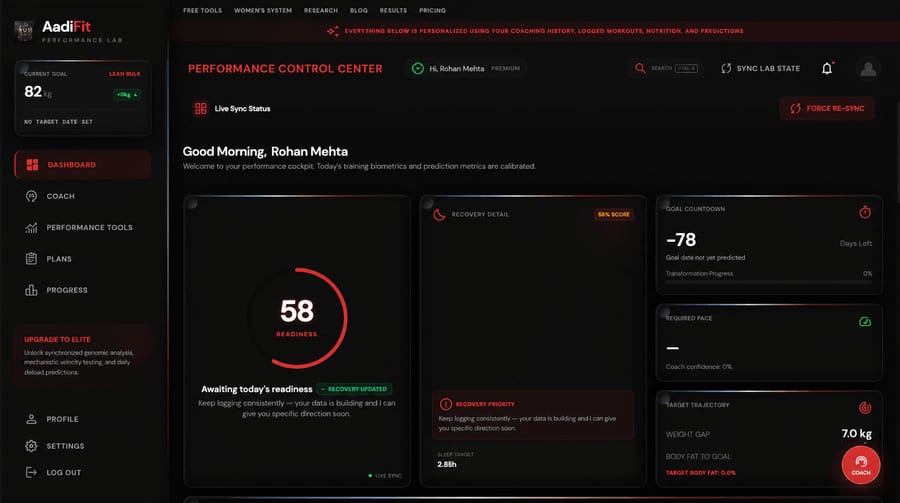
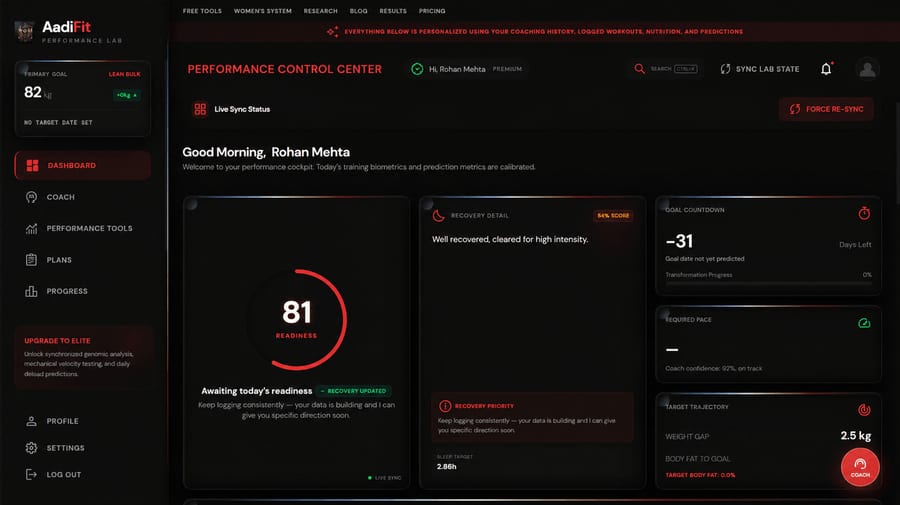
On day one, your dashboard is honest about where you stand: a readiness score with no history behind it yet, a recovery detail card that says "keep logging consistently," a goal countdown sitting at 78 days, and a weight gap of 7 kilograms with the system telling you straight, "coach confidence: 0%," because you haven't given it anything to work with yet. Most apps fake a number here. AadiFit doesn't.

Seven weeks later, with consistent check-ins, that same screen is unrecognizable. Readiness jumps from 58 to 81. Recovery detail goes from "awaiting data" to an 84% score with a specific note: well recovered, cleared for high intensity. The goal countdown collapses from 78 days to 31. The weight gap shrinks from 7 kilograms to 2.5. And coach confidence, the number that tells you whether the plan is actually on pace, climbs from 0% to 92%. That's not a mockup number. That's what seven weeks of real logging does to a dashboard built to react to your data instead of showing you the same static plan every day.

  • Readiness score: 58 → 81
  • Recovery detail: 58% → 84%, well recovered
  • Goal countdown: −78 days → −31 days
  • Weight gap to target: 7.0kg → 2.5kg
  • Coach confidence: 0% → 92%
Week 1AadiFit dashboard on day one, before check-ins are logged
Week 7AadiFit dashboard after seven weeks of logging, showing readiness score and recovery trend

Example account. Data shown is illustrative, built on the real AadiFit interface to demonstrate how the dashboard fills in over a coaching cycle.
DAILY BRIEFING

A Coach Who Actually Tells You What To Do Today

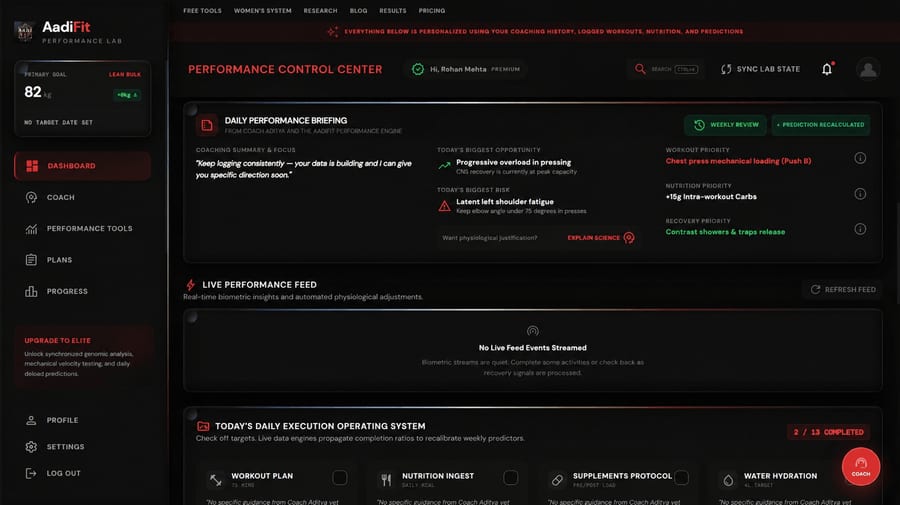
This is the card most people never get from a gym trainer: a daily briefing written specifically for where you are right now. Week one, it's honest again, "keep logging consistently, your data is building, and I can give you specific direction soon." No pretending to know things it doesn't know yet.

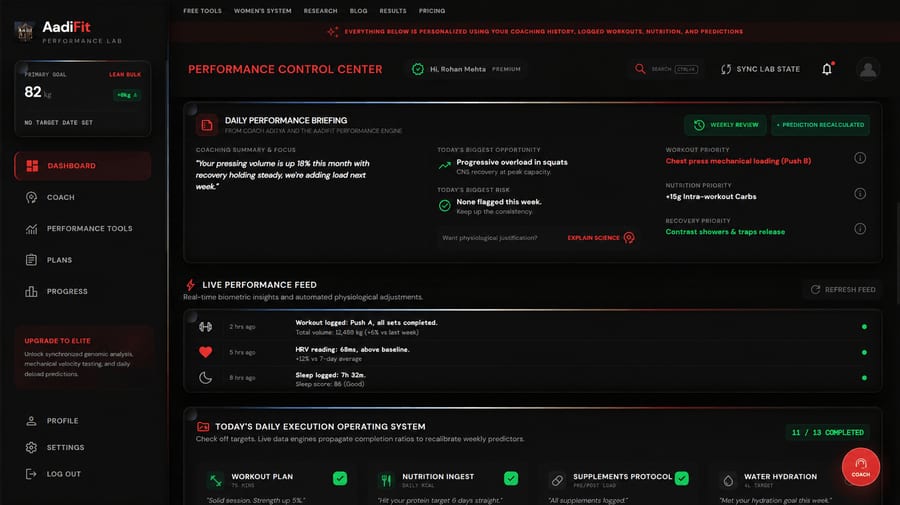
By week seven, it's a completely different conversation. The coaching summary reads "your pressing volume is up 18% this month with recovery holding steady, we're adding load next week." Today's biggest opportunity is called out by name: progressive overload in squats, CNS recovery at peak capacity. Today's biggest risk is checked and cleared. Below that, three specific priorities, one for your workout, one for your nutrition, one for your recovery, so you never open the app wondering what to actually do. And the live performance feed, empty on day one, now shows real entries: a workout logged, an HRV reading above baseline. This is what a coach who's actually looking at your data sounds like, not a generic "stay consistent" message copy-pasted to every client.

Week 1Daily performance briefing on day one, before enough data has been logged
Week 7Daily performance briefing after seven weeks, with specific training and nutrition guidance

Example account. Data shown is illustrative, built on the real AadiFit interface to demonstrate how the briefing evolves as you log data.

DAILY EXECUTION

Thirteen Boxes That Actually Predict Your Results

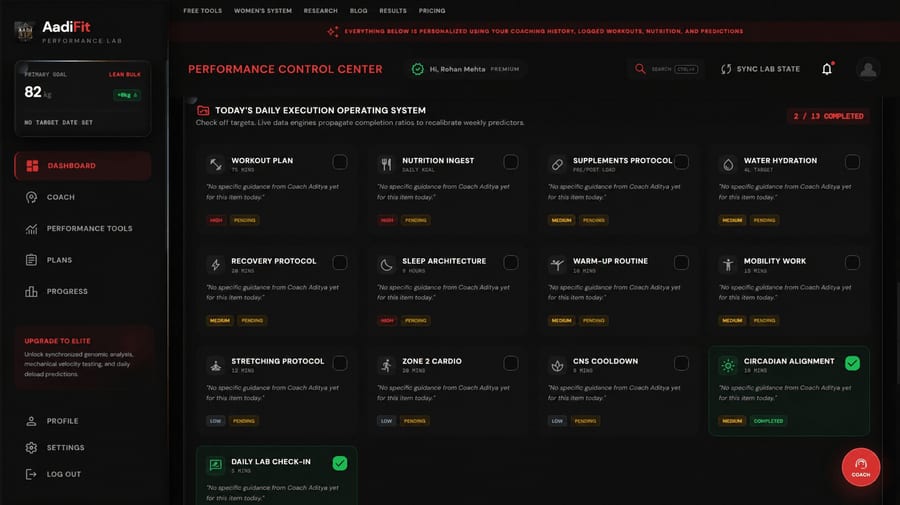
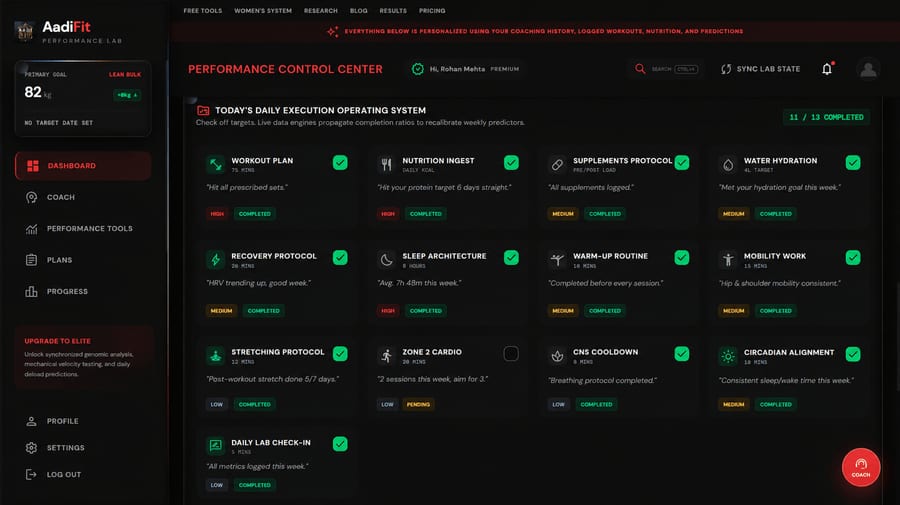
Workout plan, nutrition ingest, supplements protocol, water hydration, recovery protocol, sleep architecture, warm-up, mobility, stretching, zone 2 cardio, CNS cooldown, circadian alignment, and your daily lab check-in, thirteen items, ranked by priority, every single day. Week one you're at 2 of 13. That's normal, you're just getting started, and most of the guidance still reads "no specific direction yet" because the system hasn't seen enough of you.

Week seven, you're at 11 of 13, and the guidance on each card has become specific: "hit your protein target six days straight," "HRV trending up, good week." This checklist is the real reason plans succeed or fail. Not the plan itself, whether someone actually executes it day after day. AadiFit shows your coach exactly which of these thirteen items you're skipping, so the conversation shifts from "why isn't this working" to "here's the one thing we need to fix."

  • Checklist completion: 2/13 → 11/13
  • Guidance text: generic placeholder → specific, data-driven notes per item
Week 1Daily execution checklist on day one, mostly unchecked
Week 7Daily execution checklist after seven weeks, mostly completed with specific coaching notes

Example account. Data shown is illustrative, built on the real AadiFit interface to demonstrate the checklist over time.

PROGRESS

The Five Numbers That Tell You The Truth

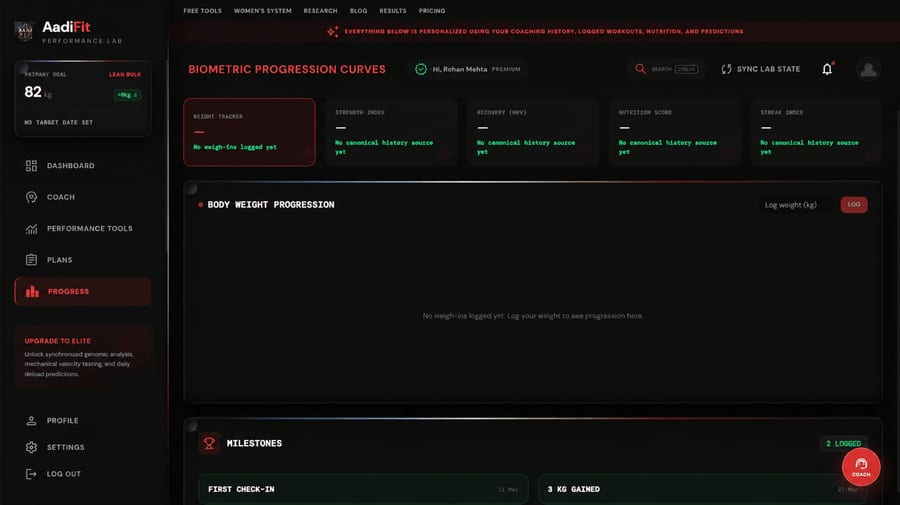
Most people track one number: the scale. AadiFit tracks five, because the scale lies constantly and a real coach never relies on it alone. Weight tracker, strength index, recovery measured by HRV, nutrition score, and your logging streak, all in one row, all empty on day one because there's no history to show yet.

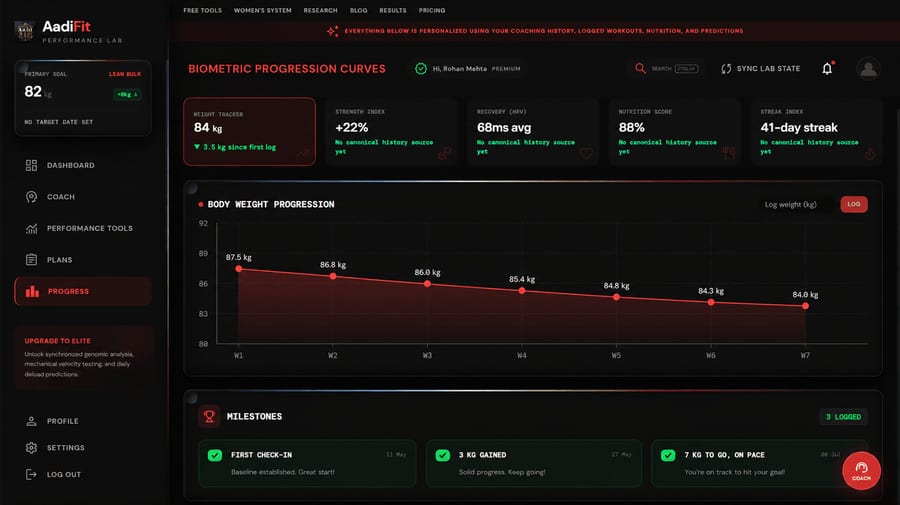
Seven weeks in, every single one has a real story. Weight tracker shows 84kg, down 3.5kg since the first log. Strength index is up 22%. Recovery, measured by HRV, sits at a 68 millisecond average. Nutrition score reads 88%. Streak index shows 41 days straight. Below the five cards, the body weight progression chart, blank on day one, now shows a real downward line across seven weekly points, and the milestones panel has a third entry: "7kg to go, on pace." This is what it looks like when a system is actually watching every input instead of asking you to trust a single number that swings 1-2kg a day from water weight alone.

  • Weight tracker: — → 84kg, down 3.5kg
  • Strength index: — → +22%
  • Recovery (HRV): — → 68ms average
  • Nutrition score: — → 88%
  • Streak index: — → 41-day streak
Week 1Progress tracking dashboard on day one, before weigh-ins are logged
Week 7Progress tracking dashboard after seven weeks showing weight trend, strength index, and HRV recovery

Example account. Data shown is illustrative, built on the real AadiFit interface to demonstrate how progress tracking fills in.

WORKOUT PLAN

Every Set You Log Builds Real Intelligence

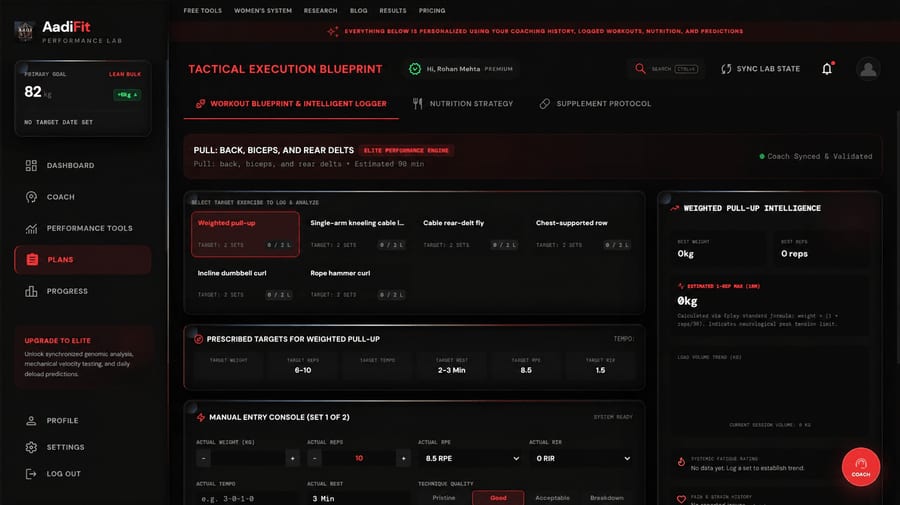
Pick a lift, weighted pull-up in this example, and AadiFit shows you a manual entry console for every set: target weight, target reps, target tempo, target rest, target RPE, target RIR. Log a set and the weighted pull-up intelligence panel updates in real time: best weight, best reps, and an estimated one-rep max calculated with the Epley formula. Day one, all of it reads zero, because there's no first set logged yet.

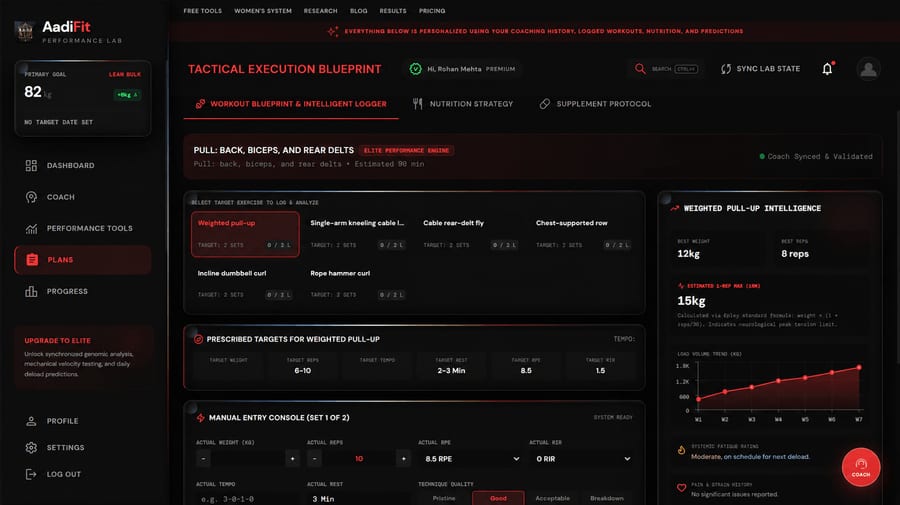
Seven weeks later, best weight climbs to 12kg, best reps to 8, and the estimated one-rep max sits at 15kg, with a load volume trend chart that actually moves upward across every session instead of staying flat. The systemic fatigue rating reads "moderate, on schedule for next deload," meaning the system isn't just tracking whether you lifted, it's tracking whether your body can handle lifting more next week. This is the difference between a workout PDF you get once and forget, and a training log that gets smarter every single session.

  • Best weight: 0kg → 12kg
  • Best reps: 0 → 8
  • Estimated 1-rep max: 0kg → 15kg
  • Load volume trend: no data → upward 7-week trend
Week 1Workout plan on day one, before any sets are logged
Week 7Workout plan after seven weeks showing load volume trend and estimated one rep max

Example account. Data shown is illustrative, built on the real AadiFit interface to demonstrate the workout logger over time.

NUTRITION

Every Gram, Every Meal, Every Day

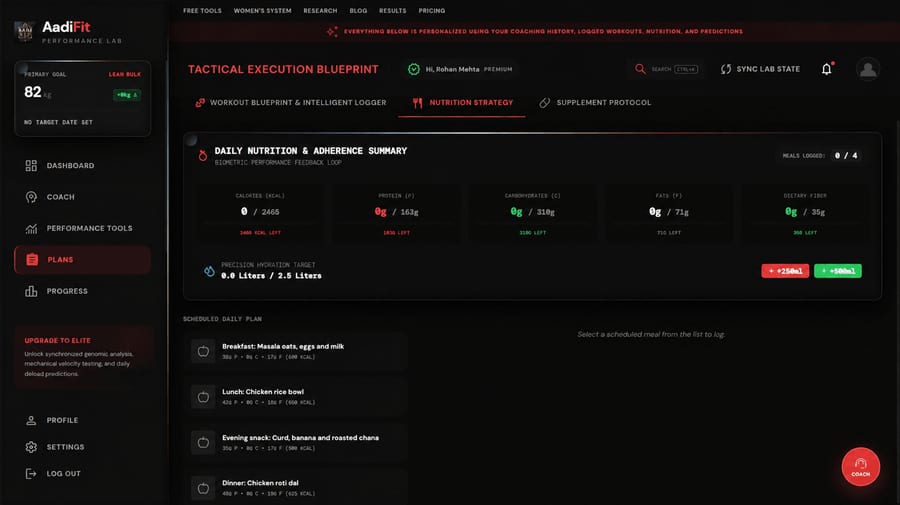
Your daily targets get set the moment you onboard, calories, protein, carbohydrates, fats, dietary fiber, and a hydration target, all calculated from your body, activity level, and goal. Day one shows those targets sitting untouched, zero meals logged out of four, zero of your 2.5 liter hydration goal met. Nobody starts perfect, and AadiFit doesn't pretend otherwise.

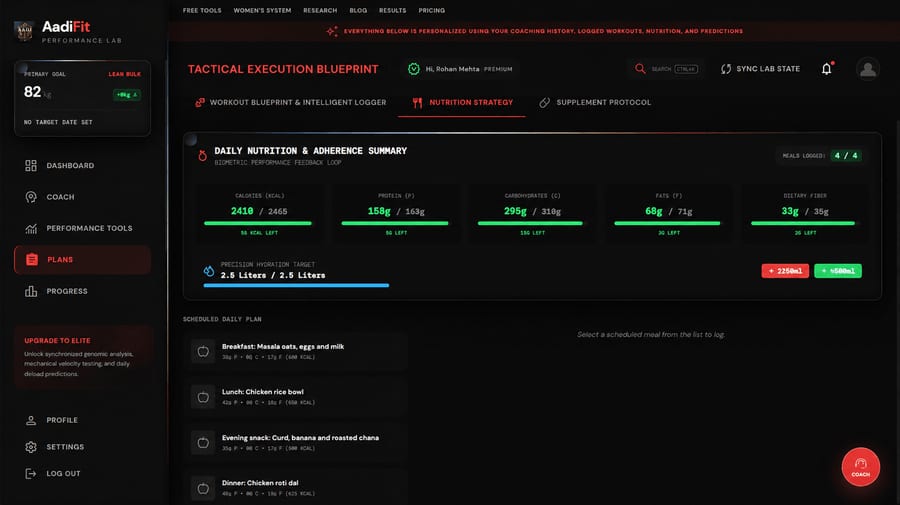
By week seven, four scheduled meals a day, logged consistently: masala oats and eggs for breakfast, a chicken rice bowl for lunch, curd and banana for an evening snack, chicken roti dal for dinner. Calories land at 2,410 of a 2,465 target. Protein hits 158 of 163 grams. Hydration reaches the full 2.5 liters. This is the actual mechanism behind why nutrition tracking works: not willpower, a system that shows you the gap between your target and your actual intake every single day until closing that gap becomes automatic.

  • Meals logged: 0/4 → 4/4
  • Calories: 0/2,465 → 2,410/2,465 kcal
  • Protein: 0g/163g → 158g/163g
  • Hydration: 0.0L/2.5L → 2.5L/2.5L
Week 1Nutrition tracking on day one, before meals are logged
Week 7Nutrition tracking after seven weeks showing consistent macro and hydration adherence

Example account. Data shown is illustrative, built on the real AadiFit interface to demonstrate nutrition tracking over time.

BODY MEASUREMENTS

What The Scale Can't Show You

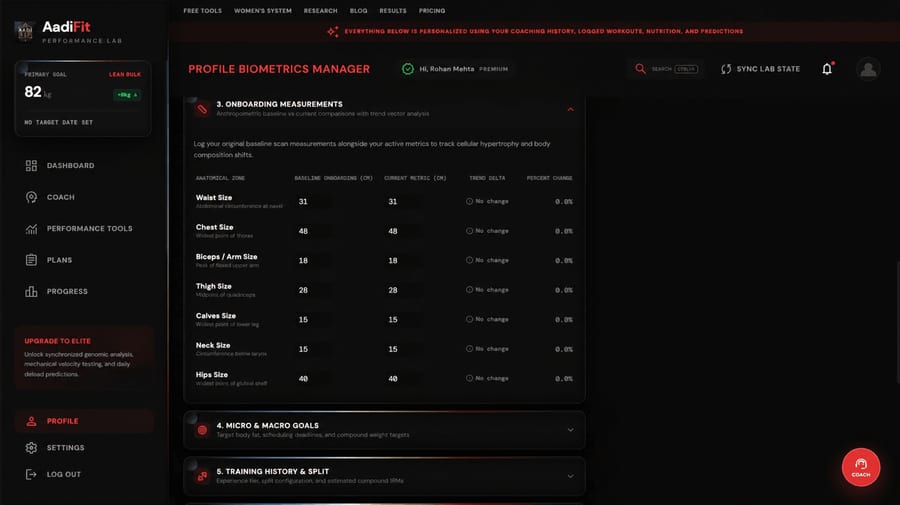
Waist, chest, biceps, thigh, calves, neck, hips, seven measurements logged against your onboarding baseline in centimeters, with a trend delta and a percent change column for each one. Day one, every row reads "no change" because baseline and current are the same number, you just started.

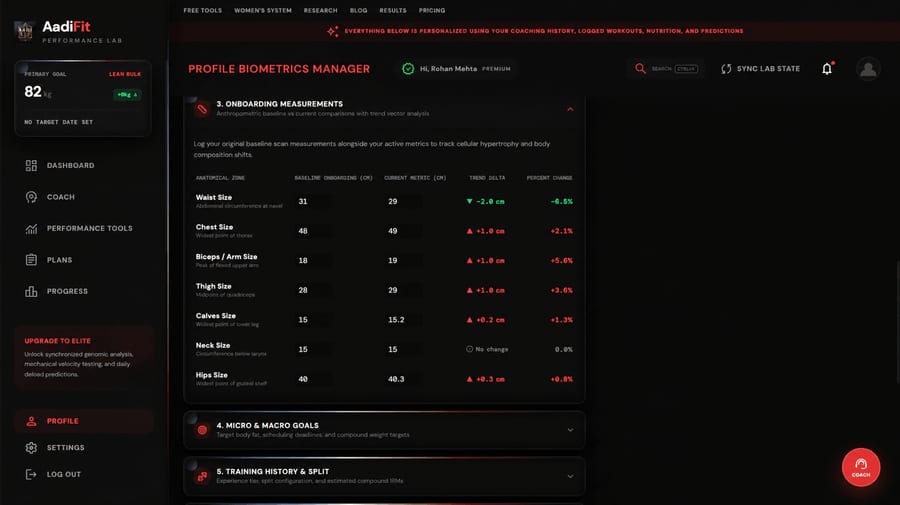
Seven weeks in, real movement shows up here well before most people would ever see it on a scale: waist down from 31 to 29 centimeters, a 6.5% reduction, chest up slightly from 48 to 49, biceps up from 18 to 19. This is exactly why relying on bodyweight alone misleads so many people into thinking a plan isn't working when body composition is actually shifting underneath a stubborn number. A gym trainer with a tape measure once a month can't give you this. A dashboard that expects you to log it weekly can.

  • Waist: 31cm → 29cm (−6.5%)
  • Chest: 48cm → 49cm (+2.1%)
  • Biceps: 18cm → 19cm (+5.6%)
  • Thigh: 28cm → 29cm (+3.6%)
Week 1Body measurements at onboarding baseline
Week 7Body measurements after seven weeks showing change from baseline

Example account. Data shown is illustrative, built on the real AadiFit interface to demonstrate measurement tracking over time.

YOUR PROFILE

One Screen That Answers "Is This Actually Working"

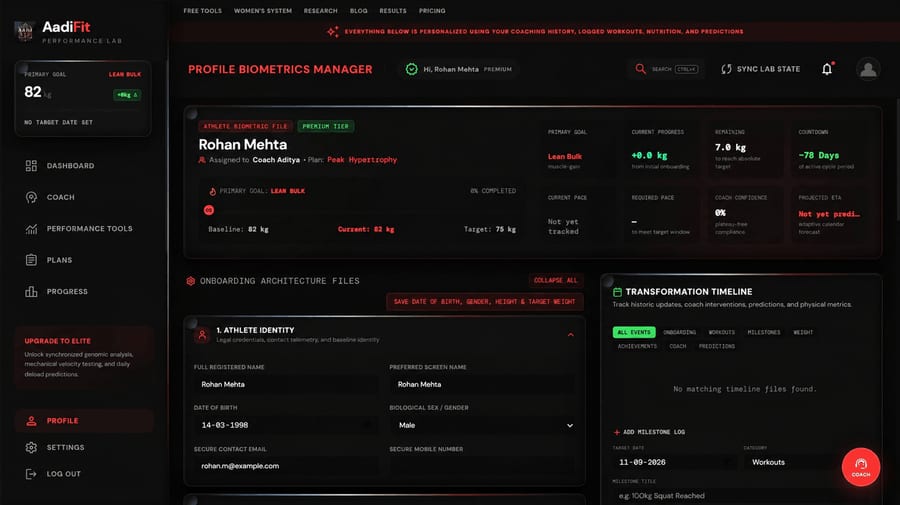
Current progress, remaining gap to target, days left on the countdown, current pace, required pace, coach confidence, and a projected completion date, every one of these sitting at zero or "not yet tracked" on day one. The transformation timeline below it reads "no matching timeline files found," because there's no history yet to show.

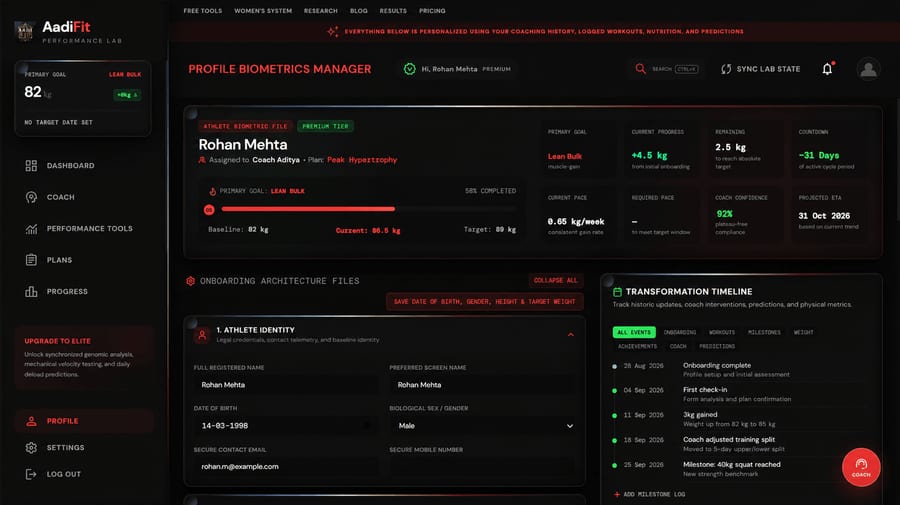
By week seven, current progress reads +4.5kg. Remaining gap has shrunk from 7kg to 2.5kg. The countdown moved from −78 to −31 days. Current pace shows a real number: 0.65kg a week. Coach confidence climbs to 92%. Projected ETA reads a specific date: 31 October 2026. And the transformation timeline fills with five real entries: onboarding complete, first check-in, three kilograms gained, a coach-adjusted training split, and a milestone, 40kg squat reached. This is the one screen that removes every bit of guesswork about whether seven weeks of effort actually did anything.

  • Current progress: +0.0kg → +4.5kg
  • Remaining to target: 7.0kg → 2.5kg
  • Coach confidence: 0% → 92%
  • Projected ETA: not yet predicted → 31 Oct 2026
Week 1Profile summary on day one, before progress data exists
Week 7Profile summary after seven weeks showing progress, coach confidence, and a full timeline

Example account. Data shown is illustrative, built on the real AadiFit interface to demonstrate the profile view over time.

SUPPLEMENT PROTOCOL

Four Supplements, Not Forty

This is the actual protocol AadiFit builds when your data calls for it: creatine monohydrate, 3 to 5 grams a day, anytime with water. Vitamin D3 and K2, 2,000 IU D3 with 100mcg K2, taken with your first meal. Omega-3 (EPA and DHA), 2 grams a day, with meals. Magnesium glycinate, 300 to 400 milligrams, 30 to 60 minutes before bed. Four items, each with a clear reason and a specific dose and timing, not the twelve-bottle stack a supplement store tries to sell you.

If your training load, sleep data, or lab results don't call for something, it doesn't appear on your list. No affiliate-driven upsells, no "just in case" additions. Only what your actual numbers support.

AadiFit supplement protocol showing dosage and timing for creatine, vitamin D3 and K2, omega-3, and magnesium
EVERYTHING WE TRACK

The Fourteen Categories A Gym Trainer Never Asks About

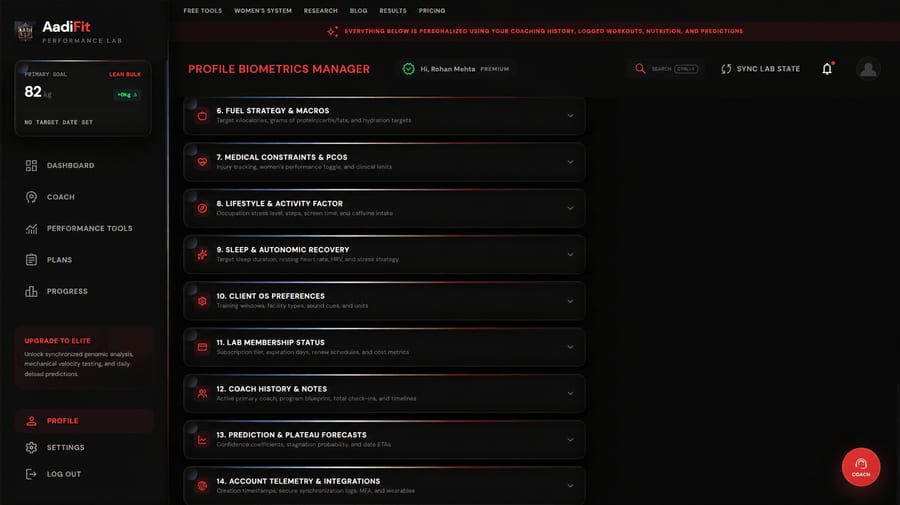
Fuel strategy and macros. Medical constraints and PCOS, including injury tracking and clinical limits. Lifestyle and activity factor, occupation stress, steps, screen time, even caffeine intake. Sleep and autonomic recovery, target sleep duration, resting heart rate, HRV, stress strategy. Client OS preferences, training windows, facility type, sound cues. Lab membership status. Coach history and notes. Prediction and plateau forecasts, with confidence coefficients and stagnation probability. Account telemetry, secure sync logs, MFA, wearable integrations.

Fourteen categories, all in one biometrics manager, all feeding the same engine that builds your plan. This is exactly what lets AadiFit personalize around your hormones and your recovery capacity, not just your bodyweight and a generic split copied from a fitness influencer. A standard gym trainer, however good, has no system built to track even half of this, let alone update your plan against it every week.

AadiFit biometrics manager showing fuel strategy, medical constraints, PCOS tracking, and sleep and autonomic recovery sections
ELITE

A Direct Line To Coach Aditya, Not A Support Ticket

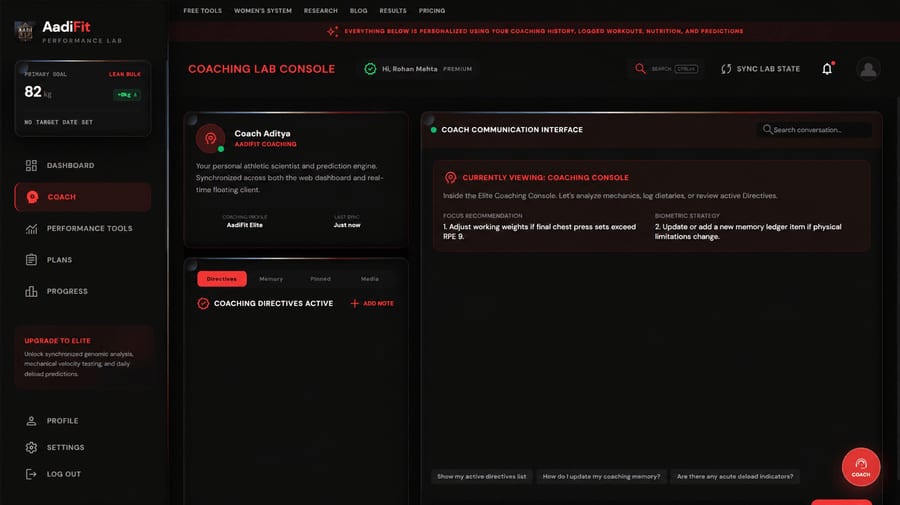
Elite members get a coaching console built for exactly one thing: a fast, direct answer. Ask about a specific set that felt off, a diet swap before a wedding, whether to push through soreness or deload, and you get a focus recommendation and a biometric strategy note back, reviewed by Coach Aditya, not a chatbot script or a three-day-later reply from a gym receptionist.

Every Elite plan also goes through a personal review step before it ever reaches you, on top of everything Premium already includes. This is the closest thing to having Coach Aditya on retainer, at a fraction of what an in-person coach with that level of access would charge.

AadiFit Elite coaching console showing direct communication with Coach Aditya
AADIFIT VISION

Your Form, Checked Before It Becomes An Injury

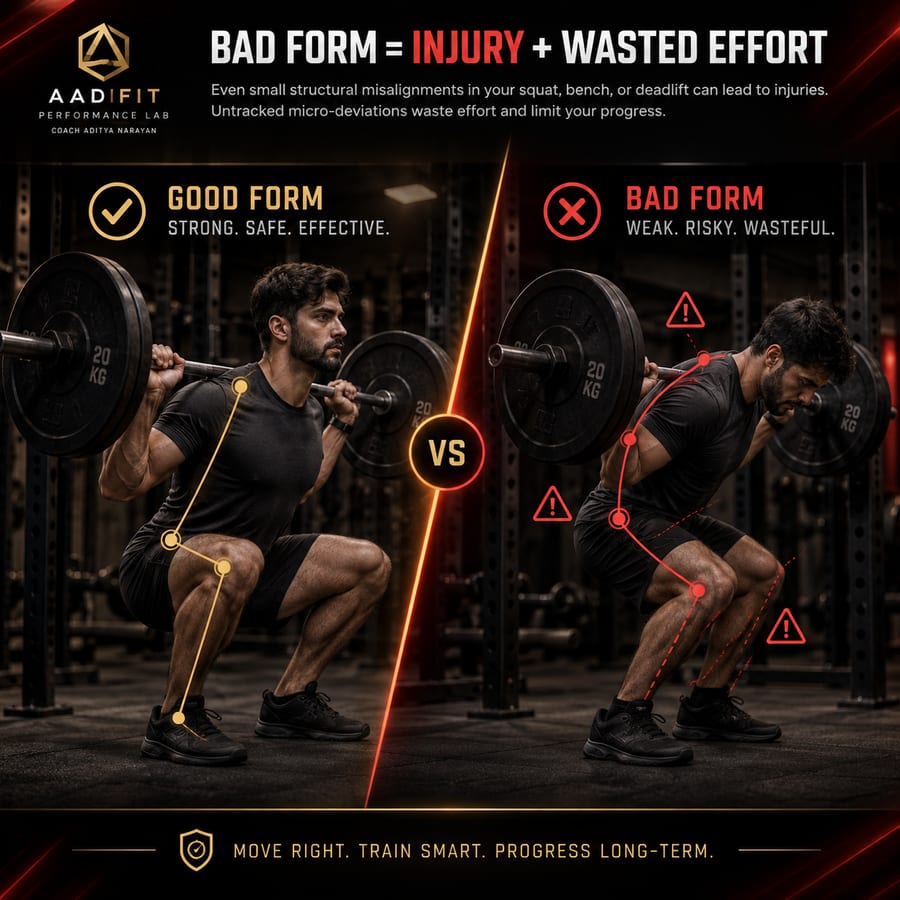
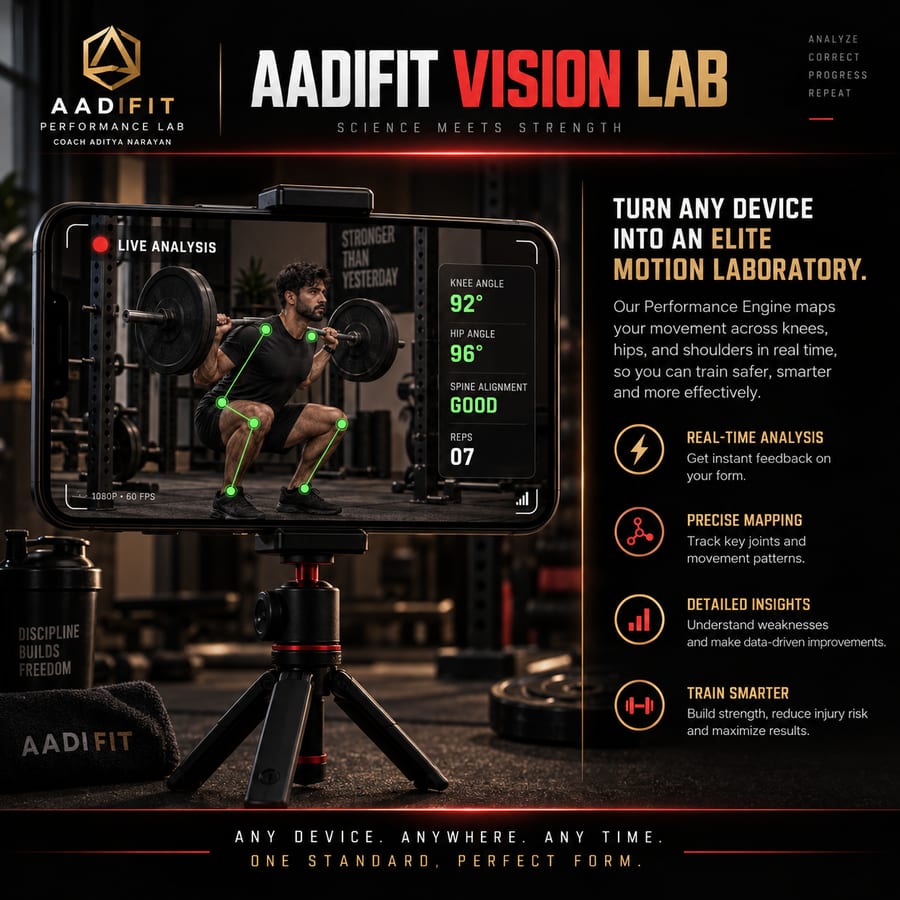
Bad squat depth, knees caving in, a rounding back under load, these are the things that quietly wreck a lifter's progress for months before anyone notices. AadiFit Vision watches the lift itself: point a phone at yourself mid-set, and it tracks your spine, hips, and knees in real time, flags exactly which joint is breaking form, and tells you what to fix on the next rep, not three weeks later when the pain shows up.

This is the same standard a good in-person coach gives you, someone physically watching your bar path and joint angles, except it's available every session, not just the ones you can afford to book. Good form gets a clear signal: strong, safe, effective. Bad form gets flagged immediately, rounded back, knees caving in, hips shifting back, before it turns into a training habit that takes months to undo.

AadiFit Vision comparing good squat form against bad squat form with joint tracking overlay
AadiFit Vision live camera analysis showing real-time knee angle, hip angle, and rep count during a squat

Concept renders illustrating how AadiFit Vision analyzes your lift, not a screenshot of the live interface.

QUESTIONS

Common Questions About AadiFit Premium

What do I actually get with AadiFit Premium?
A training split built for your goal, nutrition targets based on your body and activity level, weekly plan adjustments, recovery tracking using HRV and sleep data, and a dashboard that updates as you log workouts and check-ins.
Is my plan built by a real coach or generated automatically?
Premium plans are built by AadiFit's coaching system and published under Coach Aditya. Elite plans go through an additional personal review step before they reach you.
How is this different from hiring a personal trainer?
A personal trainer in India typically costs ₹15,000 to ₹20,000 a month for in-person sessions. AadiFit Premium is ₹1,499 a month and covers training, nutrition, recovery, and hormonal health tracking, all in one dashboard you can use anywhere.
What data does AadiFit use to personalize my plan?
Your onboarding measurements, training history, sleep and HRV data, check-in responses, and for women, cycle phase and PCOS or hormonal considerations where relevant.
How long until my dashboard has enough data to be useful?
Your plan is personalized from day one based on your onboarding data. Trend data like recovery scores, strength progression, and predictions build up over the first 2-3 weeks of logging.
Are the dashboard screenshots on this page from a real user?
No. They are example accounts built on the real AadiFit interface to show how the dashboard evolves over a coaching cycle. This is disclosed under every image on this page.
Can I cancel my AadiFit Premium membership anytime?
Yes. There is no lock-in contract. You can cancel anytime from your account settings.
What is AadiFit Vision?
A camera-based form check. Point your phone at yourself during a lift and AadiFit Vision tracks your spine, hips, and knees in real time, flagging form breakdowns like a rounding back or knees caving in as they happen, not after the session.
READY WHEN YOU ARE

Your Dashboard Is Waiting To Fill In

Everything on this page starts blank, exactly like your account will. The only difference between week one and week seven is you showing up and logging it. Start free, no credit card, and watch your own numbers move.

₹1,499/month
Start Free Assessment → View Full Pricing →
7-day money-back guarantee · Cancel anytime · No lock-in contract